Sunday, September 7, 2008

40-40-29


With all of the banners and streamers that have been placed around Mbabane the past week, it’s been hard not to think two things. First: something big is happening. And second: this is a country that knows how to celebrate.


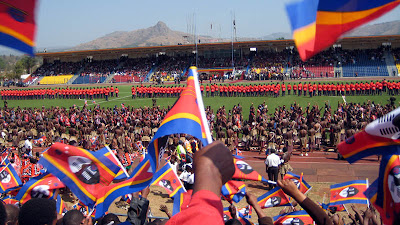
Yesterday was the big 40-40 event here, the double celebration of Swaziland’s 40th year of independence (actual date, September 6, 1968), and King Mswati III’s 40th birthday (actual date, sometime last April). To commemorate the occasion, there was a big party in the main stadium, complete with entertainment, marching and military displays, and heads of states and other dignitaries from a number of (mainly southern African) nations. The party also fell on my 29th birthday.


Nick, Shubha, and I went out to the stadium at around 9am yesterday and found some space in one of the bleachers. The ceremony took a long time, as the dignitaries’ arrivals stretched for over an hour. Heads of state from Lesotho, Malawi, Mozambique, Rwanda, Tanzania, Zambia, Zimbabwe, and the SA Zulu Nation all arrived and were announced to the crowd, which was close to 100,000. The largest cheers – besides for Mswati – went to the Vice President of Taiwan to Zimbabwe’s Mugabe.

Swaziland is one of the few countries to recognize Taiwan’s sovereignty, and reaps a lot of benefits in terms of aid and investment from throwing its weight around on Taiwan’s behalf in the UN and other multilateral bodies. The Taiwanese have a big presence here, and it’s clear that the crowd was responding to them. It’s less clear to me why Mugabe got such a big hand, as most of what I’ve heard from locals about him isn’t at all positive.


The 40-40 celebrations have been controversial here as a large, vocal group has seen it as a big indulgence. I haven’t seen a price tag put on the event in the papers here, but a lot of money has been thrown into it – and not always wisely.

Each of the visiting dignitaries rolled into the stadium in a brand-new USD$100,000+ BMW. The government bought 20 new cars, and – after the news of the expense made its way into the paper – a minister announced that they had always intended to sell the cars immediately after the 40-40. Five of the BMWs have since been taken off the sale block, and will likely end up in the garages of the royal family, ministers, or other connected people. There have been other grandiose expenditures, including a shopping trip in Dubai for 8 of Mswati’s wives. (This article in the NYT recounts Mswati’s extravagance in the face of the nation’s poverty, and captures a lot of the complicated sentiment here about the King and his spending.)

Nick, Shubha, and I lasted through the introductions, a lengthy marching band session, and a few speeches, before ducking out at around 1pm. After the event, I felt the itch to get out of Mbabane and drove down to Maputo for the night. I caught some live music, met some bribe-loving Maputo police officers (once for taking an “illegal” U-turn, and the second time for Driving While White), and toured around the city before heading back to the Swaz.

Sunday, August 31, 2008

So what is it… you would say… that you… do… here?

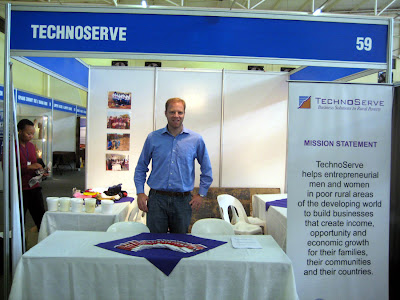
Earlier this week I spent the day at the Swaziland International Trade Fair, where TechnoServe set up a booth to promote a number of its programs and the work that the organization does within Swaziland. After spending the day communicating the mission and programming at the fair, I thought I’d write a bit about TechnoServe generally, and what we’re doing in Swaziland.
TechnoServe’s mission is to create jobs, income, and economic growth for the rural poor. We do this by identifying and working with small and medium enterprises (SMEs) and individual entrepreneurs, and providing business planning advice, technical help, access to finance, and other services that will help businesses grow, and help the benefits flow down to the poor. In addition to working hands-on with specific businesses, TNS also runs a number of programs aimed at raising the business literacy and stoking the entrepreneurial drive of the population here.

In Swaziland, most of the consulting engagements focus on a handful of industries: agriculture – mainly horticulture (e.g. vegetables) and feed & livestock, handcrafts, and tourism. TNS is selective about the engagements it takes on, and does its best to identify clients with the potential to maximize impact among the poor.

While TNS works with individuals, a more typical project would be to provide support for a project management office (PMO), which would oversee and support a larger group of smallholder farmers.

For example, TechnoServe is working with a company here that specializes in the production of chili mash, which is the main ingredient in Tabasco-brand sauce, which all of you have seen in restaurants and supermarkets in the US. TNS helped this company pilot a program to grow chili peppers, provided technical support for growing, and helped arrange the market for the mash with the Tabasco company, and was involved in financing the capital investment required. Our client oversees the production of the mash, and sources chilies from a number of rural smallholder growers. Chilies are a good and profitable crop to grow in Swaziland – technically it is not that difficult, and there is a guaranteed market for them through this project. TNS has helped to pilot this vegetable, and is hoping that to roll it out on a larger scale.

In all of the work, the importance of the entrepreneur is high. It takes committed individuals to start or grow an enterprise, especially in a business climate as difficult as Swaziland's. TNS will look for an individual or small team to work with that could help drive forward different projects.

In Swaziland the entrepreneurial spirit is lagging, and these individuals are hard to find. To help foster a better environment, TNS sponsors three country-wide initiatives – SAYE (School-Aged Youth Entrepreneurship), The Business Place (TBP), and Believe, Begin, Become (a business plan competition, or BPC).

SAYE is targeted at primary and high school students, and is an elective program that students could sign up for. They work with about 50 schools nationwide and put together a number of classes that teach economics, financial literacy, and decision making skills, and other initiatives (such as a program where classes organize and run their own business out of their schools).

The Business Place is the project I’ve been working on, which will be a physical business resource center located in the countryside, where farmers and other small business operators could walk-in and receive a variety of management and technical help. TBP’s focus is to be accessible to its clients, and the center will provide resources to smallholder farmers who otherwise would lack access to them. The center also will incubate a number of shared services and increase coordination between farmers, lenders, and PMOS.

The last initiative is a business plan competition, where TNS solicits individuals to start or improve a small or medium business. TNS takes the participants through a variety of trainings to help develop their plans, which are presented to a judging panel at the end of the competition. Prizes include seed capital and vouchers for professional services.

Throughout all of the work, TNS takes a scientific approach. Most of the staff and volunteers here come from management consulting backgrounds, and projects are selected and conductive based on industry analysis, feasibility studies, and study of data (which could be hard to come by) of potential impact. As a result there’s this interesting and somewhat exotic mix of business and agriculture, with a good dose of silliness/frustration negotiating the sometimes difficult and arduous Swazi business culture.

Swaziland’s size presents a challenge to TNS’ work here. The country is small, and it’s difficult to identify projects and interventions that will have the same scale of impact that they would elsewhere. For example, in East Africa, TNS works largely in the coffee and cashew sectors, both of which (coffee especially) are huge industries with high potential for impact. An intervention in the coffee value chain could bring higher prices and more income to probably millions of individuals. In Swaziland – a country with a population of just over a million, and with great diversity in geography and climate (and thus in what crops grow in what areas) – there’s no industry with anything close to that scale. The industry that comes nearest is sugarcane, which is seeing prices decline over the next few years. This is a huge challenge, and makes TechnoServe’s work much more one-off and labor intensive than it would elsewhere.

Between learning about sugar cane, agriculture, small business, social investment, micro-finance, and development work, it’s all quite an education.

Sunday, August 24, 2008

Yebo & Stout

There's been a mass exodus of TechnoServe volunteers the last few weeks, as five have returned to the States to go back to work or school. With everyone leaving, it's been nice to welcome two new house guests, who will be staying with us for the next month.
Liz, one of the outgoing volunteers left her two cats, with us temporarily until they find a permanent new home with a friend from the Clinton Foundation in mid-September. With a new home, we christened them with new names - Liz had named them Bogani and Mouphle, two SiSwati names, but they didn't fit well with their personalities.

Yebo (pronounced YAY-boh - the gray and white cat) is the friendlier and more curious of the two. He rolls around the house, jumps up into your lap, and purrs like a motor. Yebo means "Yes" in Siswati, and reflects Yebo's outgoing ways. The word is also used as to acknowledge a greeting, to answer the phone, to voice agreement, and in many other ways that I'm just starting to understand. There are lots of ways to say "yebo" (YAY-boh, YAAAAY-boh, and yay-BOH are some to start with), and each intonation conveys a different meaning and context.

Stout is a bit more reserved, but equally affectionate once he gets to know you. Stout spent a good deal of time the hanging out under my bed the first few days, and is now branching out to the rest of the house. Stout's named after his color - a dark black with a few patches of white - in honor of Castle Milk Stout, the beer of choice in the apartment.

Wednesday, August 13, 2008

HIV / AIDS

Last week I had two experiences which shed more light on the HIV situation in Swaziland for me. A couple of colleagues and I were invited to spend our lunch hours at an orphanage in Mbabane this past Wednesday, and on Friday we toured an HIV clinic on the outskirts of town here.

HIV / AIDS is a huge issue in Africa in general, and Swaziland in particular. It’s the number one problem that this country and continent face, and it’s claiming millions of lives. Swaziland has been particularly affected, and until recently had the unhappy distinction of having the highest HIV infection rate in the world (39-42%, depending on the survey – and that’s the official percentage for those who have been tested; estimates are much higher – 60% or more – for the general population), and the shortest life expectancy of any nation in the world (32).

The country hasn’t dealt with the problem effectively. A few years back the official HIV strategy announced by the King was a four-year prohibition of sex for all women under a certain age, a ban which the King broke several times. Through polygamy, lack of robust prevention policies and health care, and the stigma of the disease, HIV spread and has devastated the country.

While I don’t see the impact of HIV directly through my work, it’s impossible to be in Swaziland and not see the reach of the disease. There are things that you notice right away – all throughout the country the population is very young; there are relatively few elders. And there are tons of children – mainly HIV orphans – all throughout the country, and especially in the rural areas. Single mothers or grandmothers become caregivers for six, eight, ten or more children. They have few ways to earn money, and little resources to pay for food, clothes, and school fees. It makes the job of raising a child, the experience of growing up, and the prospect of lifting a country out of poverty extremely difficult propositions.

Working for TechnoServe in Mbabane, I’m a bit removed from seeing the impact of HIV. A Swazi colleague, Gail, took a few of us in the office to tour an orphanage where she volunteers. The orphanage was run by a US expat from Alaska, who came to Swaziland as a pediatric nurse and ended up moving here with her husband and taking on this project. Many of the twenty-one children were HIV orphans.

The orphanage was a really great facility. Most of the children are between two and five (with one or two older children) and were taken into the orphanage when they were very young. They live in one of three houses, each with a House Mother who is their primary caregiver. There was a shared playroom and nursery school, and the houses were clean and cheerful. The orphanage has a lot of local support and connections for supplying good, healthy food, and the expat who leads the project receives sufficient funding, mostly from the states. From Gail’s judgment, it seemed to be one of the best-equipped, well-run orphanages in Swaziland.

Visiting the HIV clinic was a similar experience. I’ve met a number of doctors who are working here through the Baylor International Pediatric AIDS Initiative, and two of my neighbors – Peluca and Lucia – are Spanish doctors working at the clinic. Peluca and Lucia gave us a tour of the clinic last Friday. Unfortunately, on Friday the clinic is closed to patients, but we got a good look at the building – the most modern building I’ve seen yet in Swaziland, well on par with or beyond many of the medical facilities being used in the U.S. – and a bit of a background about the epidemic.

The clinic provides care to any HIV positive child up to 15 years old, and their caregivers - parents, grandparents, guardians, etc. (Like all clinics in Africa, HIV care is delivered free of charge.) While the clinic is meant to test, diagnose, and treat HIV, they also end up providing general medical care for these children and their families.

We saw what may have been the best HIV and orphanage facilities in the country, which painted a rosy picture of the epidemic. Rosy or not, there are a couple of things that are clear about AIDS and HIV.

The first is that the epidemic needs to be controlled before any meaningful progress – economic, social, or otherwise – could take place in Swaziland. Meaningful economic development will continue to take a back seat to AIDS in Swaziland for a while; it’s hard to promote business and an entrepreneurial culture on a large scale in an environment where family structures are destroyed, caregivers have eight or more children to tend to, the life expectancy is so low, and education gets a back-seat due to HIV. While there are a number of different organizations here involved in HIV/AIDS, TechnoServe is the only non-Swazi NGO in the economic development space. Unfortunately Swaziland does not seem to be on the shortlist of countries to enter for many other development organizations or foreign direct investment.

The second, more encouraging, thing is that the crisis is now in the forefront, and there are huge efforts and big money behind prevention and treatment efforts. Looking at the Baylor facility and speaking with Peluca and Lucia, it’s clear that there’s money available, mainly from major foundations in the US and Europe. Swaziland has also embraced prevention efforts – billboards here promote monogamy, safe sex, or compliance with treatment options; free condoms are offered in office bathrooms, at government offices, and border crossings; images of red ribbons are common on newspapers and official documents; and there are constant reminders and announcements at concerts and events. Awareness is now embedded in the culture here.

Despite the money and promotion, beating AIDS here is a monster task, and implementation is extremely difficult. The doctors at Baylor face treatment compliance/adherence problems (patients may not take pills, and often don’t come to the clinic as needed because of high transportation costs, etc.), government bureaucracy (connecting the Baylor database with the Mbabane hospital DB has been a real problem), and social problems (a big stigma still persists). They’re optimistic, but also realistic about the enormity of the problem. A number of Peace Corps volunteers I’ve met, who are stationed in the countryside, are less optimistic, as they’ve been close to the problem and have spent too many days attending funerals in their villages. It’s a rural country, and a number of the PC volunteers have written off the development prospects for Swaziland as a whole.

I’m reminded of a speech a few years ago by a former US Ambassador to the UN whose name I can’t remember and whose speech I can’t find online. In the speech he asks how could the West have turned their eyes to the crisis that was unfolding in Africa, and the millions of lives being lost. It’s clear that there’s attention on the problem now, but there’s a lot of work to do.

Friday, August 8, 2008

King Mswati III... Annoyance

Just another intra-office email in Swaziland.

From: Linda
Sent: Thursday, August 07, 2008 4:42 PM
To: TechnoServe Swaziland
Subject: Please do not use your parking space tomorrow - (45 - 60)

Dear All,

The King will be coming tomorrow to bless the Insurance Building next door and the Landlord has requested that we do not use our parking space from number 45 to 60. This will be a morning function and after 2pm you can then use your parking spaces.

Apologies for the inconvenience that maybe caused by this.

Regards,
Linda

Thursday, July 24, 2008

This Blog Posting Has Been Approved

I spent much of my time the first couple of weeks in Mbanane getting various documents stamped. Show my passport at the airport. Stamp! Submit an application for a work permit. Stamp! Register a Swazi company. Stamp! Open a corporate bank account. Stamp! Stamp! Stamp!

Swazis seem to like stamps - stamping documents, inspecting stamps, sharing stamped documents with other Swazis, looking at unstamped documents and shaking their heads back and forth, etc. Nothing could get done unless the supporting documentation was stamped. The annoying thing was that there often seemed to be no rhyme or reason as to why something needed a stamp to be processed. The trick seemed to be more about locating who held the stamp that you needed and how you could find them than producing anything particular about the application you were pushing through.

After some frustrating times getting various things stamped (and some fleeting moments of pure satisfaction upon getting things stamped) I decided to get my own stamp made. It's beautiful, round, and self-inking, and extremely satisfying to pound down onto a document or a note.

Sunday, July 20, 2008

Cape Town, in a Nutshell


Flew in Friday night. Yesterday: hike up to the top of Table Mountain, Manchester United - Kaizer Chiefs friendly soccer match, Thai dinner, Long Street bars. Today: brunch on the waterfront, Chapman's Peak drive, Boulder Bay penguins, Cape Point and Cape of Good Hope, Franschhoek dinner. Plans for tomorrow: District Six Museum, Robben Island, Lion's Rump hike. Tuesday: The Business Place visit, fly to Jo'burg.